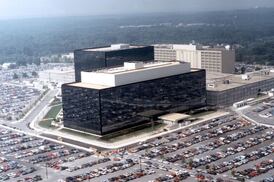

WASHINGTON — An internal network the National Security Agency uses to communicate classified information was offline Tuesday after what the agency described as “routine maintenance.”
The problem disrupted the operations of NSANet, a classified internal network used by employees of the agency, according to a defense official who was not authorized to discuss the matter by name and spoke to The Associated Press on the condition of anonymity.
“The National Security Agency experienced temporary degradation during scheduled routine maintenance," the NSA said in a statement. “While some internal systems were affected, mission-critical capabilities remain fully operational and our ability to defend national security continues. NSA’s infrastructure is designed with multiple layers of redundancy to maintain operations during planned maintenance or unexpected events.” The intelligence agency did not provide any additional details on the cause of the outage or the scope of the disruption.
The outage was first reported by CNN.
The NSA episode is among a series of cyber-related disruptions to critical government and private sector functions in the last week, including a system overload Friday that resulted in a ground stop of air traffic in the United States, a technical issue at JPMorgan Chase on Monday that caused ripple effects in the financial system and an internal systems outage at United Airlines that delayed departing flights. On Tuesday , Apple acknowledged on its system status page that its Apple Music, App Store and AppleCare services suffered full outages after an internal update.
None of the outages has been attributed to a cyberattack or nefarious activity.
“This is not a cyber attack and this is not a coordinated effort by a nation-state,” Jay Clayton, the Trump administration's director of national intelligence, said in a CNBC interview Tuesday about the spate of disruptions. He attributed the problem instead to the fact that government institutions and private companies were pushing through upgrades of their computer systems around the same time, resulting in periodic technological hiccups.
“Many people are patching their systems. They know that their legacy systems have vulnerabilities. They're outdated, they don't work well with new systems. It is time for an upgrade across our digital infrastructure. And as you patch and upgrade your systems — taking them down and bringing them back up — there are things like this that happen,” Clayton added.
Sen. Mark Warner, the Democratic vice chairman of the Senate Intelligence Committee, echoed that assessment.
“AI is making it possible to identify vulnerabilities across enormous numbers of systems at unprecedented speed, creating enormous pressure on companies and government agencies to patch those vulnerabilities immediately, often all at once, putting tremendous strain on systems that weren’t built to handle that pace of change,” Warner said in a statement. “While we still need to get to the bottom of these incidents, the evidence so far points toward legitimate efforts to secure our systems, not malicious activity.”
Copyright 2026 The Associated Press. All rights reserved. This material may not be published, broadcast, rewritten or redistributed without permission.